
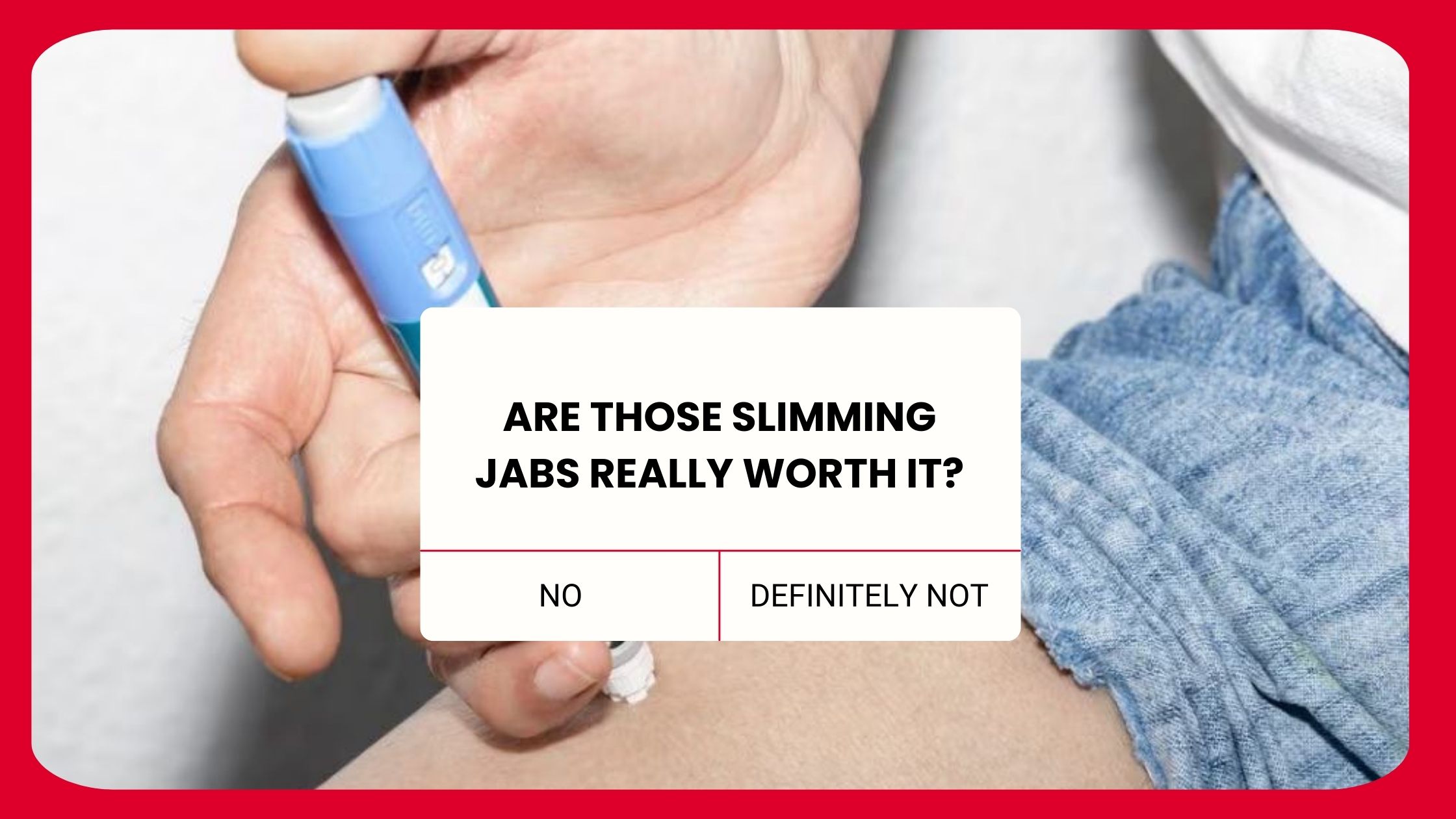
Weight-loss injections have become one of the most talked-about tools in modern dieting.
For many people, they genuinely feel revolutionary: appetite quiets down, food noise fades, and weight starts to come off — often for the first time in years.
But a crucial question is now being asked more loudly by researchers and clinicians alike:
What happens when the injections stop?
Recent large-scale research suggests that for many people, weight regain after stopping slimming jabs happens not just quickly — but significantly faster than after lifestyle-based weight loss.
That doesn’t mean the medication “fails”.
It means weight loss is more complex than appetite suppression alone.
And understanding why this happens is the key to building results that actually last.
What the Latest Research Shows
A major systematic review published in The BMJ analysed data from more than 30 clinical studies involving GLP-1 receptor agonists — medications originally developed to manage type 2 diabetes and now widely prescribed for weight loss.
The findings were consistent:
- Participants lost meaningful amounts of weight while taking the medication
- Once the medication was stopped, weight regain began quickly
- On average, weight was regained at a rate ranging from around 0.4 to 0.8 kg per month, depending on dose and duration of use
At the higher doses typically prescribed for weight loss, this rate of regain means many people return close to their pre-treatment weight within around 12–18 months.
This aligns with reporting from BBC News, which highlighted that people using slimming jabs for obesity treatment often regain weight at the upper end of this range.
Crucially, when researchers compared these outcomes with people who lost weight through dietary and behavioural interventions, they found that weight regain after stopping injections occurred roughly four times faster than after lifestyle-based weight loss.
The takeaway isn’t that medication is “bad”.
It’s that how weight loss is achieved matters – especially once the external support is removed.
Why Weight Regain Happens So Quickly
This pattern fits closely with what we already know about human physiology.
GLP-1 medications work by:
- Suppressing appetite
- Slowing gastric emptying
- Increasing feelings of fullness
What they don’t automatically do is:
- Build sustainable eating habits
- Preserve muscle mass without resistance training
- Improve sleep, stress, or food quality
- Guarantee that metabolic improvements persist after stopping
When weight is lost — by any method — the body responds defensively.
Decades of research show that after weight loss:
- Hunger hormones increase
- Satiety hormones decrease
- Energy expenditure drops (a phenomenon known as adaptive thermogenesis)
This creates a powerful biological push toward weight regain.
When appetite suppression is removed without new habits or metabolic resilience underneath, the body is essentially primed to regain — fast.
This isn’t a lack of discipline.
It’s biology doing exactly what it evolved to do.
Appetite Suppression vs Metabolic Health
One of the biggest misunderstandings in modern weight loss is the idea that controlling appetite alone equals metabolic improvement.
But research consistently shows that:
- Weight loss without metabolic improvement is fragile
- Loss of lean muscle increases the likelihood of regain
- Blood-sugar instability continues to drive hunger long after appetite suppression ends
A landmark study published in The New England Journal of Medicine found that hormonal changes promoting hunger and weight regain persisted for more than a year after weight loss — even when participants were highly motivated to maintain their results.
This helps explain why weight often returns rapidly once an external control, such as medication, is removed.
Why Lifestyle Change Produces Slower — But More Durable — Results
Dietary approaches that focus on blood-sugar regulation, protein intake, food quality, and muscle preservation tend to produce changes that last beyond the active weight-loss phase.
Low-carbohydrate, whole-food approaches have been shown to:
- Improve insulin sensitivity
- Reduce hunger over time
- Preserve lean muscle mass
- Improve metabolic markers alongside weight loss
A major review published in The BMJ found that low-carbohydrate dietary approaches were associated with meaningful improvements in metabolic health markers, particularly in people with insulin resistance or type 2 diabetes.
These improvements matter because metabolic health doesn’t disappear when a programme ends.
The Skill Most Weight-Loss Methods Don’t Teach
One of the biggest limitations of slimming jabs is that they don’t teach people how to eat without them.
When hunger is chemically suppressed:
- Food decisions aren’t practised
- Habit loops aren’t rebuilt
- Confidence around eating isn’t restored
Education-based approaches, by contrast, focus on:
- Understanding hunger versus cravings
- Recognising blood-sugar signal
- Choosing foods that naturally regulate appetite
These are skills.
And skills don’t vanish when a programme ends.
Where Real Meal Revolution Fits In
At Real Meal Revolution, the goal has never been rapid weight loss at any cost.
Instead, we help people learn how to:
- Stabilise blood sugar through real food
- Eat in a way that supports hormones
- Reduce cravings without white-knuckling
- Build habits that survive busy, imperfect lives
That’s why RMR programmes focus on education, structure, and sustainability not appetite suppression or short-term fixes. Come and take a seat at our 6-week Perfect keto course, to help guide you on a long lasting journey to a healthier you.
Medication may be a useful tool for some people.
But without lifestyle change alongside it, the evidence increasingly suggests the results are temporary.
The Bigger Picture
Weight regain after slimming jabs isn’t a personal failure.
It’s a predictable biological response when appetite is controlled externally without durable metabolic change underneath.
Lasting progress doesn’t come from silencing the body.
It comes from understanding it.
And that’s why, time and again, lifestyle-based approaches grounded in real food, metabolic health, and practical education continue to outperform trends built on quick results.
If you want results that last, the answer isn’t doing more to your body.
It’s learning how to work with it.
References:
- West, S. et al. (2024).Weight regain after cessation of medication for weight management: a systematic review and meta-analysis.
- BBC News (2024).People who stop slimming jabs regain weight faster than dieters.🔗 https://www.bbc.com/news/articles/c050ljnrv2qo
- Rosenbaum, M., & Leibel, R. L. (2010). Adaptive thermogenesis in humans.The American Journal of Clinical Nutrition🔗 https://academic.oup.com/ajcn/article/92/4/782/4597310
- Sumithran, P. et al. (2011). Long-term persistence of hormonal adaptations to weight loss.The New England Journal of Medicine 🔗https://www.nejm.org/doi/full/10.1056/NEJMoa1105816
- Goldenberg, J. Z. et al. (2021). Efficacy and safety of low and very low carbohydrate diets for type 2 diabetes remission.The BMJ 🔗https://www.bmj.com/content/372/m4743
- Harvard T.H. Chan School of Public Health Metabolism and weight regulation.🔗 https://www.hsph.harvard.edu/obesity-prevention-source/obesity-causes/metabolism-and-weight/
Optional “Further Reading” (if you want to go deeper)
Wilding, J. P. H. et al. (2021). Once-weekly semaglutide in adults with overweight or obesity. NEJM
🔗 https://www.nejm.org/doi/full/10.1056/NEJMoa2032183Rubino, D. et al. (2021). Effect of continued weekly subcutaneous semaglutide vs placebo on weight maintenance. JAMA
🔗 https://jamanetwork.com/journals/jama/fullarticle/2777886
